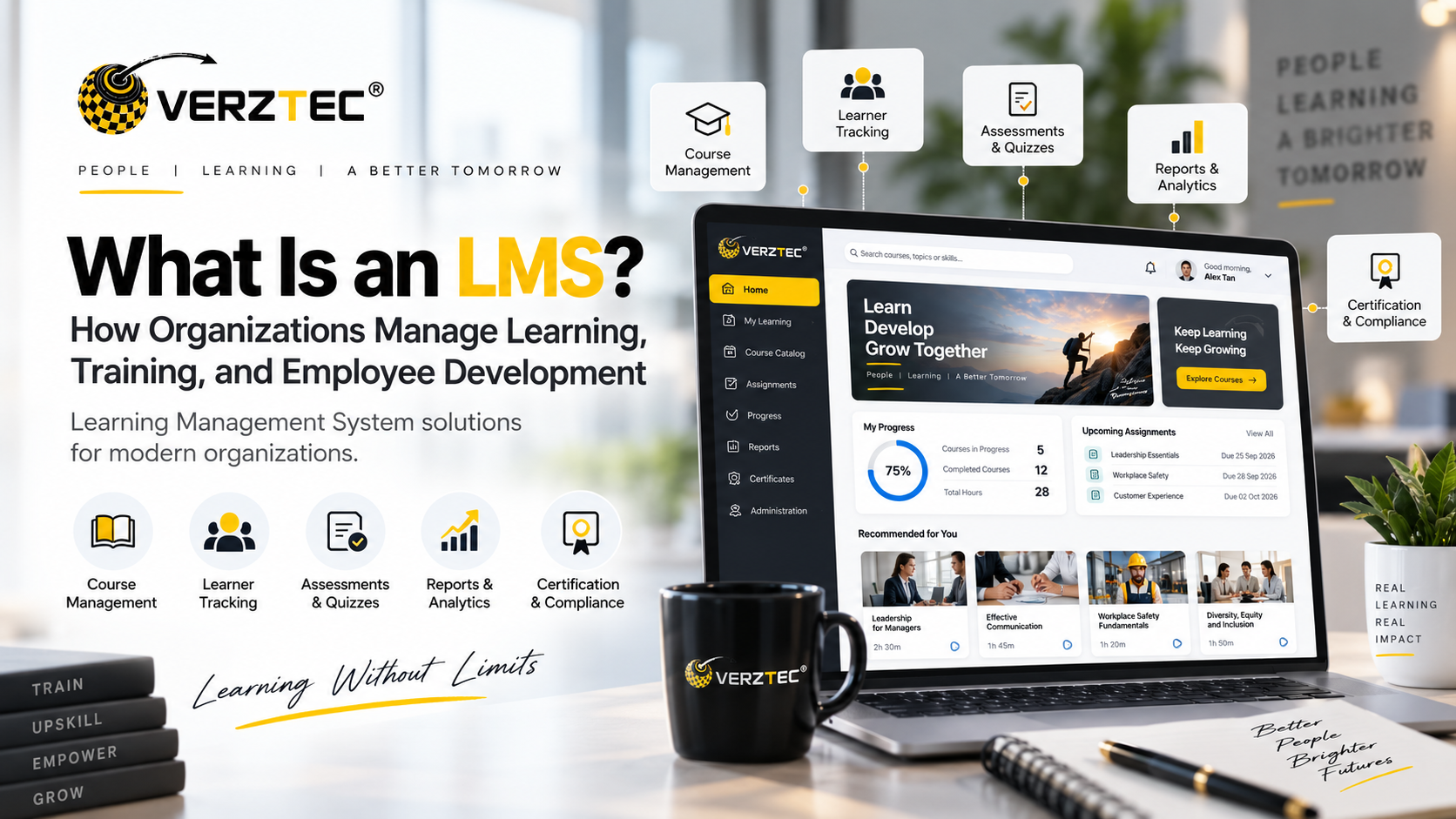
A Learning Management System (LMS) is a centralized platform that helps organizations manage employee learning and training online. It supports the entire learning process, from course and learner management to assignments, assessments, progress tracking, and reporting.
What Can an LMS Do?
An LMS helps organizations manage multiple areas of learning and training, including:
• Course Management
Create, organize, and manage training courses within a centralized system.
• Learner Management
Organize employees into departments, job roles, teams, or other groups based on organizational requirements.
• Course Assignment
Assign specific courses to individual employees or groups based on their roles and training requirements.
• Learning Progress Tracking
Monitor course participation, completion status, learning progress, and assessment results.
• Quizzes and Assessments
Use quizzes, tests, and assessments to evaluate learners' understanding after completing training.
• Reports and Analytics
Track learning data and generate reports to support training management and workforce development.
For example, an organization with 500 employees that requires everyone to complete workplace safety training can use an LMS to assign the course, allow employees to access the training online, and monitor completion from one centralized platform instead of distributing files and collecting results manually.
What Types of Organizations Can Benefit from an LMS?
An LMS can be useful for organizations that:
• Have a large number of employees
• Operate across multiple branches or locations
• Provide recurring employee training
• Require mandatory or compliance training
• Need to track employee learning progress
• Want standardized training across departments
• Need learning reports for HR, management, or compliance purposes
An LMS can support both small and large organizations, depending on the learning requirements, number of users, and complexity of the training process.
LMS for Employee Training
Organizations can use an LMS for many types of employee training, such as:
• New employee onboarding
• Compliance training
• Workplace safety training
• Product knowledge
• Sales training
• Customer service training
• Professional skills development
• Internal policies and procedures
Because training content is managed through one system, employees can access assigned courses according to their roles and responsibilities.
What Is the Difference Between an LMS and e-Learning?
An LMS and e-Learning are related, but they are not the same.
e-Learning refers to digital learning content, such as videos, animations, interactive lessons, quizzes, and SCORM courses.
An LMS is the system used to manage and deliver that learning content.
For example, an organization may create an e-Learning course about workplace safety and upload it to an LMS. The LMS can then assign the course to employees, track their learning progress, record assessment results, and generate reports.
In simple terms:
e-Learning = Learning Content
LMS = Learning Management System
Using both together allows organizations to build a more structured and measurable learning environment.
What Should Organizations Consider When Choosing an LMS?
Before implementing an LMS, organizations should consider several factors.
1. Number of Users
The system should support the current number of employees as well as future organizational growth.
2. Course Management
The LMS should make it easy to create, upload, categorize, assign, and update courses.
3. Learning Standards
Organizations using e-Learning content should consider support for learning standards such as SCORM.
4. Reporting and Analytics
The LMS should provide useful reports for monitoring participation, completion, assessment results, and employee development.
5. User Experience
The system should be easy for both learners and administrators to use across desktop and mobile devices.
6. Integration
For larger organizations, the LMS may need to integrate with HR systems, employee databases, Single Sign-On (SSO), or other enterprise applications.
7. Customization
Organizations may require customized workflows, user roles, branding, reports, or other features based on their internal processes.
How Verztec Supports LMS Development
Every organization has different learning processes, employee structures, and reporting requirements.
Verztec provides Learning Management System development and corporate learning solutions that can be customized to support an organization's specific requirements.
Our LMS solutions can support functions such as course management, learner management, learning assignments, assessments, progress tracking, reporting, certification, and integration with e-Learning content.
Verztec also provides e-Learning development, SCORM content, video learning, learning design, translation, and localization services, enabling organizations to build an integrated learning ecosystem.
Looking for an LMS for Your Organization?
If your organization is planning to implement a new LMS or improve an existing learning platform, start by identifying your training requirements, number of users, learning content, reporting needs, and integration requirements.
Talk to the Verztec team to explore an LMS solution that fits your organization's learning and employee development goals.
Request an LMS Consultation
Request a Quotation
Learn More About LMS and e-Learning Solutions
Summary
An LMS, or Learning Management System, is a centralized platform that helps organizations manage employee training and learning.
It can be used to manage courses, learners, assignments, assessments, progress tracking, reports, and certifications.
When combined with e-Learning content, an LMS enables organizations to provide structured, scalable, and measurable employee training across departments and locations.